Philippines now averages 70 COVID-19 fatalities a day
Aug 30 2020
[Disclaimer: Whatever is written here is based on information released by the Department of Health (DoH) at the time of publication. Whatever changes DoH makes in their data later on…well that’s a different story in itself and as they say in their disclaimer: “the total cases reported may be subject to change as these numbers undergo constant cleaning and validation.”]
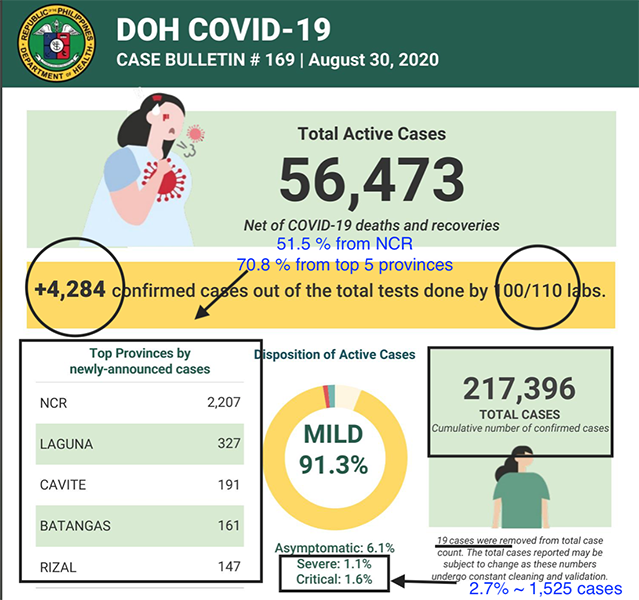
With 4,284 newly announced cases (with 88 percent recent and 12 percent as backlogs) the country’s total is now at 217,396.
National Capital Region (NCR) contributes 2,207 cases (51.5 percent of the total) today. The other four provinces in the top five are all from Calabarzon: Laguna, Cavite, Batangas and Rizal. In fact, Region IVA alone has 874 (20.4 percent of total cases) newly announced cases today.
There are now 56,473 active cases due to the weekly clean up drive of the data with 2.7 percent severe or critically ill (around 1,525 cases up from 1,425 yesterday). [Whether they are hospitalized or not, is not indicated by the Health Agency.]
Incidentally, 19 cases were removed from the total case count (no reason provided).
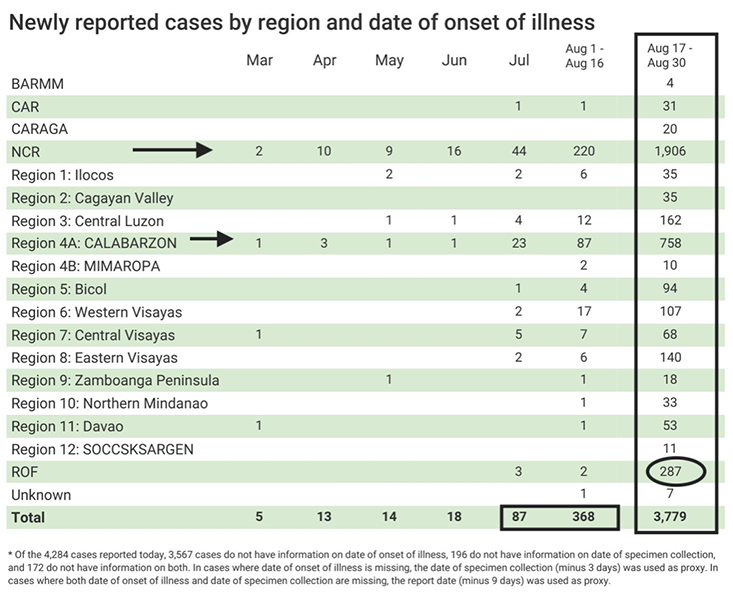
The Health Agency divides its report either as recent (last 14 days) or as “backlogs.”
Of the 4,284 cases today, 3,779 (88 percent) are recent (from the period August 17 to 30, 2020) while the remaining 505 are backlogs. The bulk of the backlogs are from August 1 to 16 (368 cases) and July (87 cases), with cases still being reported all the way back from March for NCR and Region IVA.
Back in the top contributors to today’s numbers are the ROF (previously called repatriates) with 293 reported.
“Of the 4,284 cases reported today, 3,567 (83 percent) do not have information on date of onset of illness, 196 do not have information on date of specimen collection, while 172 do not have information on both.”
(Yet the Department of Health uses the Date of Onset of Illness in their reporting for some inexplicable reason.)
“In cases where date of onset of illness is missing, the date of specimen collection (minus three days) was used as proxy. In cases where both date of onset of illness and date of specimen collection are missing, the report date (minus nine days) were used as proxy.”
There is a new group called ROF (which the DoH does not explain). These are actually the former repatriates.
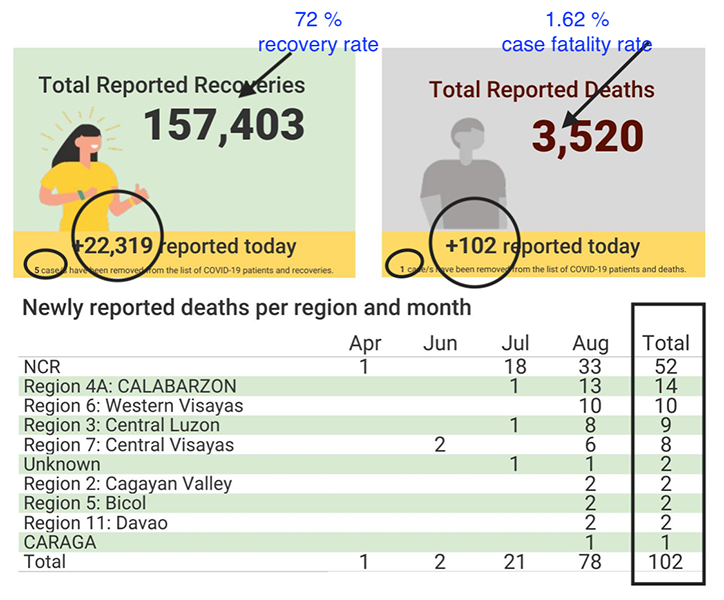
There were 22,319 recoveries [with five cases being removed from the recoveries—because they were non-COVID cases ?] bringing up the recovery rate to 72 percent (higher than the global average of 69.6 percent).
The spotlight for the day are the continued death reports, and is summarized below in the week in review.
There were 102 deaths reported today: 52 from NCR (51 percent of total), 14 from Calabarzon, 10 from Western Visayas, nine from Central Luzon, eight from Central Visayas; two each from Cagayan Valley, Bicol, Davao; one from Caraga, and two unknown regions.
Of the reported deaths, 78 (76.5 percent) occurred this month, 21 in July and two in June and one as far back as April.
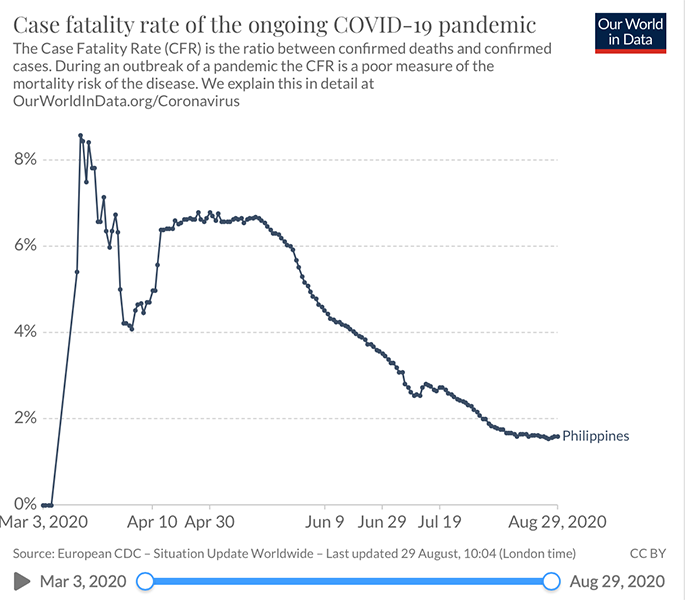
With over 100 deaths, the case fatality rate is now up at 1.62 percent.
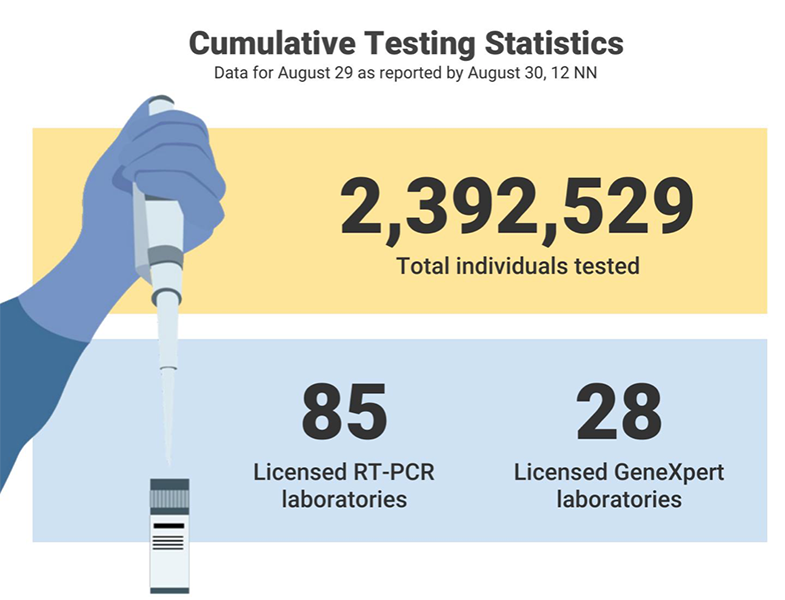
There are now 113 testing facilities (85 RT-PCR and 28 GeneXpert). Data for August 29 reported on August 30 shows that 2,392,529 individuals (2.2 percent of the population) have been tested. The breakdown will be provided tomorrow.
The day yesterday
Testing capacity
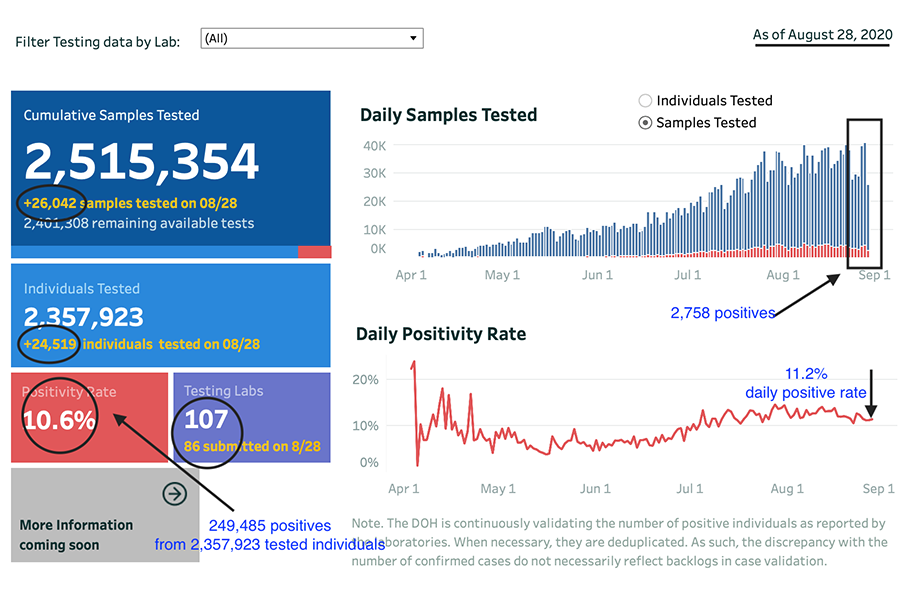
Based on the data of August 28, 2020, a total of 2,357,923 individuals have been tested with report coming from 86 of 107 laboratories. There were 2,758 positives from 24,519 individuals tested.
The daily positivity rate is at 11.2 percent with the cumulative positive rate steady at 10.6 percent.
Of 2,758 positives, 1,989 were from NCR testing centers (72 percent of total). The daily positivity rate of NCR was 14.5 percent with a cumulative positive rate of 12.5 percent.
The summary
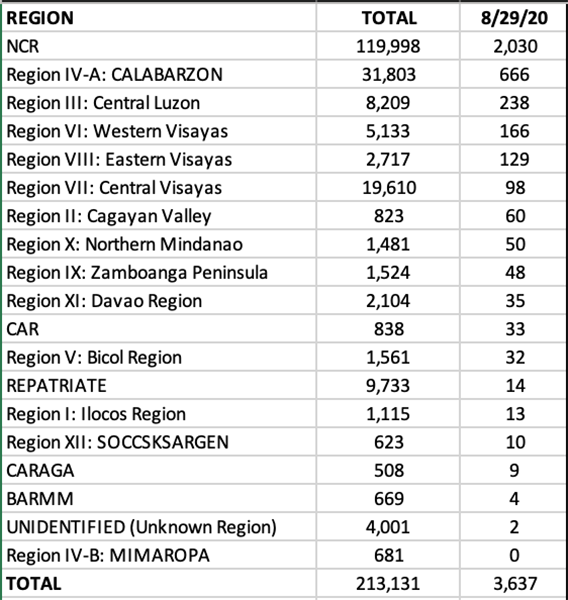
As of yesterday, the Philippines had 213,131 confirmed cases with NCR owning almost 57 percent of the total cases to date.
There were only 14 new cases from the repatriates bringing their total to 9,690 to date (fourth in overall total). Incidentally, the Health Agency now calls them ROF (returning overseas foreign workers?).
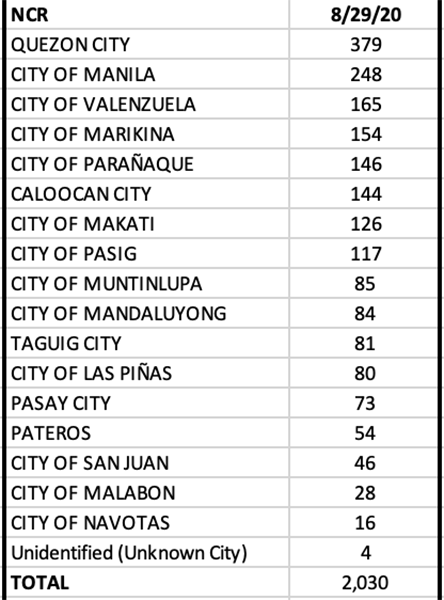
For August 29, 2020, NCR had 2,030 new confirmed cases with Regions IVA, III, VI, and VIII rounding up the top regions.
There were two cases with no tagged location on a regional level. There are now over 4,000 individuals with no tagged location at the regional level.
Region IVB did not register any case yesterday and two other regions registered single digit: Caraga and BARMM.
The unknown
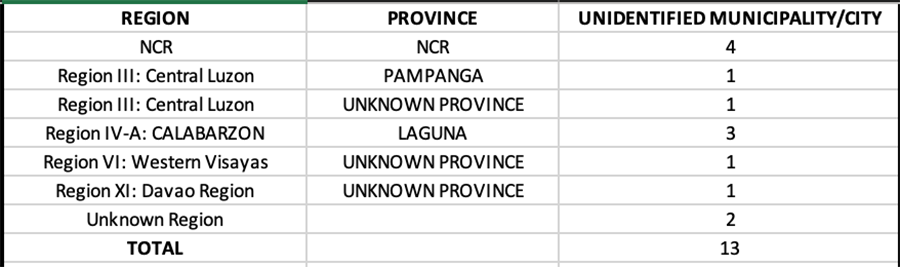
There were 13 unknowns (0.4 percent) with no tagged location on various levels among the top five regions: one with no known region, three with no known province (one in Central Luzon, one in Western Visayas and one in Davao). The rest were unknowns on a city/municipality level. Even NCR had only four unknowns at this level.
The known
Eight cities in Mega Manila continue to report three digits, with Quezon City (of course) in front with 379 cases. Manila, Valenzuela, Marikina, Parañaque, Caloocan, Makati, and Pasig round up the rest.
The remaining cities reported double digits.
Muntinlupa, Mandaluyong, Taguig, Las Piñas, Pasay, and Pateros reported 50 or more cases per city.
San Juan, Malabon, and Navotas reported fewer than 50 cases per city.
Only four cases had no tagged location at the city level.
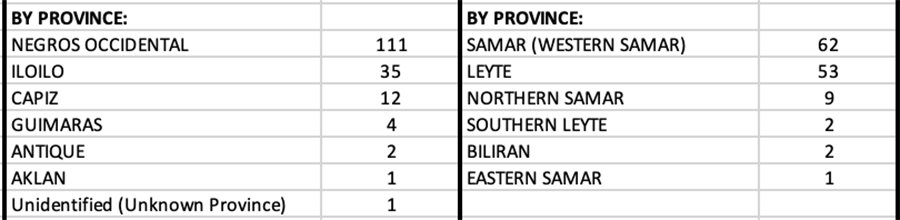
The following provinces had the highest cases for their respective region: Laguna for Region IVA, Bulacan for Region III, Negros Occidental for Region VI, and Western Samar for Region VIII.
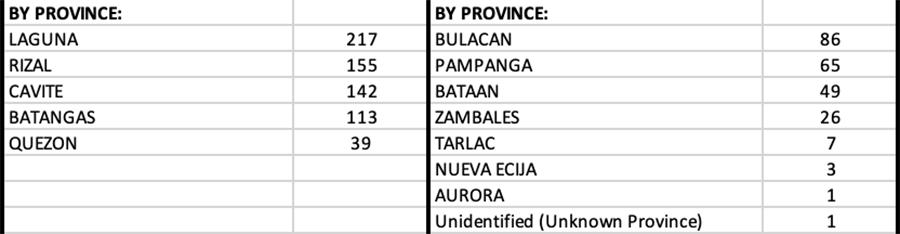
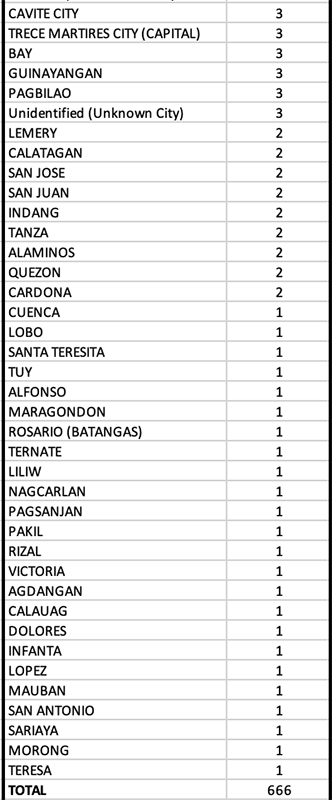
Region IVA reported a total of 666 (how more ominous can you get) cases yesterday with Laguna, Rizal, Cavite, and Batangas reporting triple digits.
But it was Calamba that led in the overall haul of cases among 21 cities and/or municipalities reporting double digits.

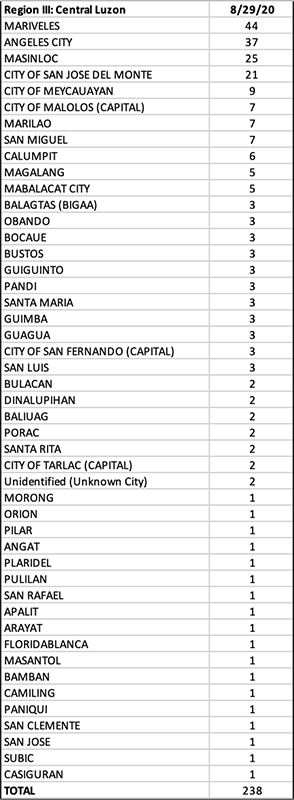
Region III was in third with Bulacan and Pampanga registering the most number of cases on a provincial level.
On a city/municipality level, Mariveles (in Bataan) led with 44 cases as this municipality owned 90 percent of the total cases in Bataan alone! Angeles, Masinloc and San Jose del Monte rounded up the other cities/municipalities with double digits.
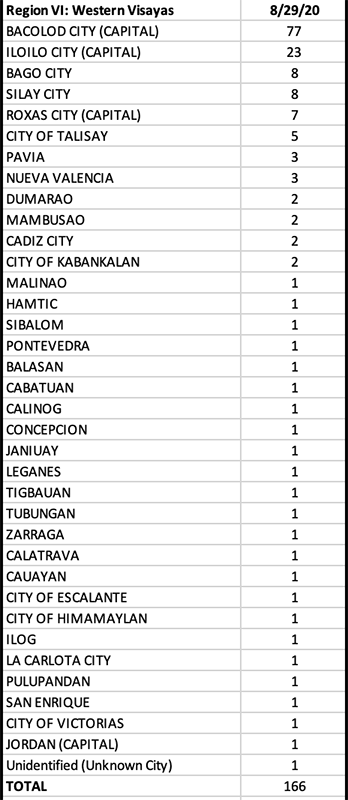
Region VI was in fourth with Negros Occidental reporting 111 cases yesterday. Bacolod owned 77 of the reported cases in this province (~ 70 percent). There were 23 cases from Iloilo City while the rest of the cities/municipalities reported single digit.
There was one unknown case from this region.
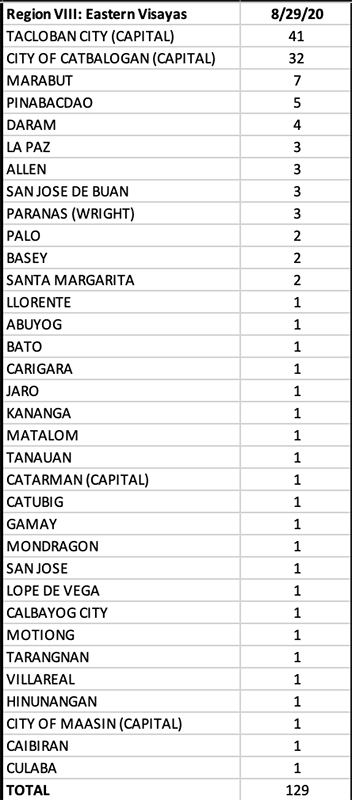
Region VIII is back in the top five with Western Samar and Leyte at the front of the pack on a provincial level.
At the city/municipality level, Tacloban led with 41 cases followed by Catbalogan with 32 cases.
The healthcare capacity
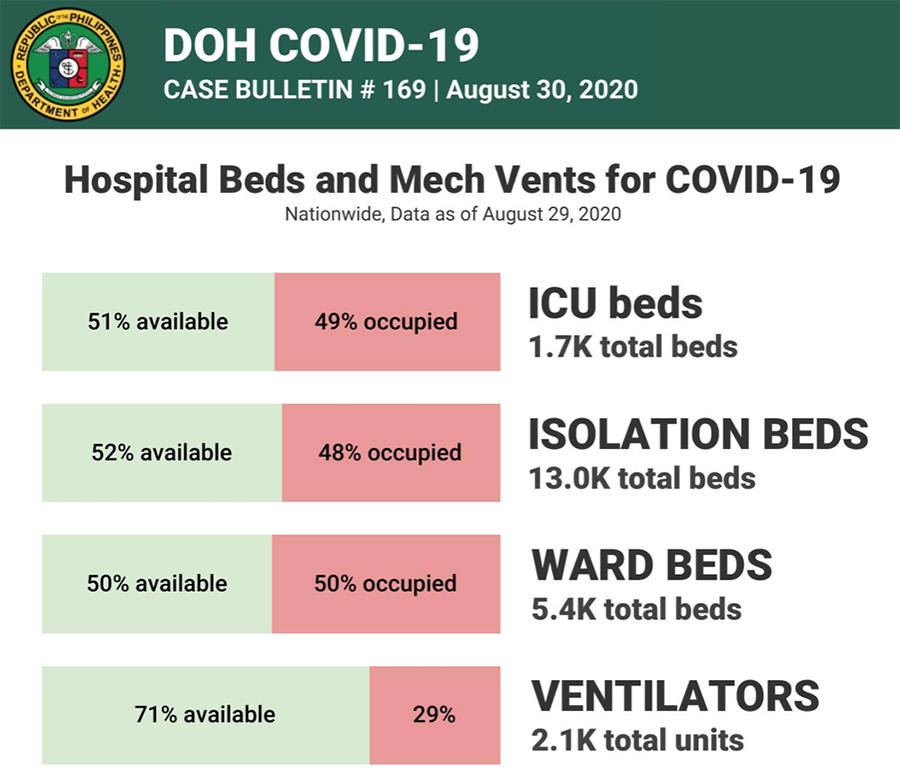
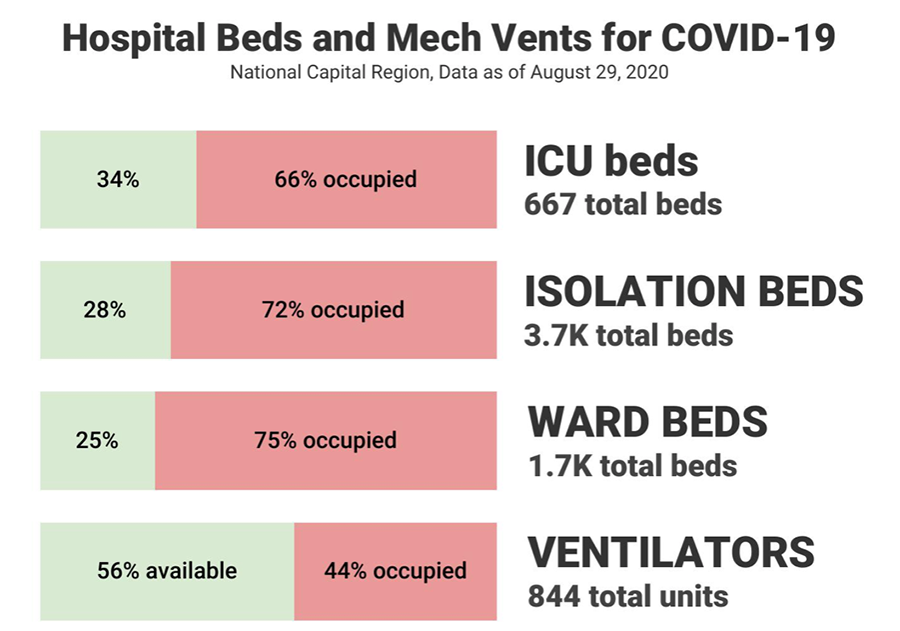
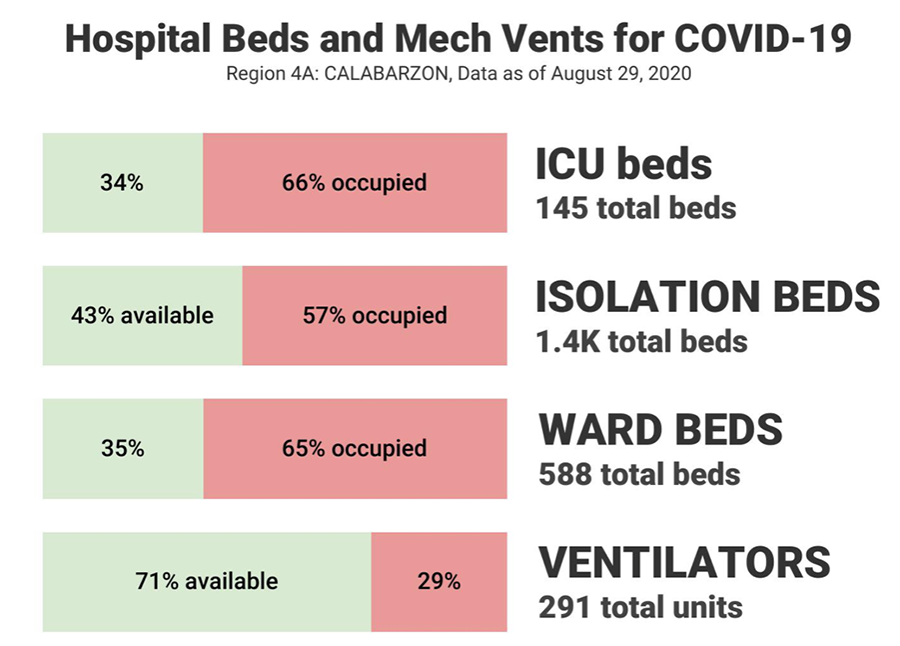
The overall healthcare system for the Philippines isn’t doing too badly. Based on the nationwide data, the healthcare capacity does not seem overwhelmed. However, this isn’t granular data and it’s a different picture when you break it down to the two large epicenters in the country, NCR and Calabarzon.
With the number of cases still escalating in NCR and CALABARZON, I have reservations on the accuracy of these numbers considering that the severe and critical patients have increased overnight, basing it on the disposition of the Health Agency and their statistics above.
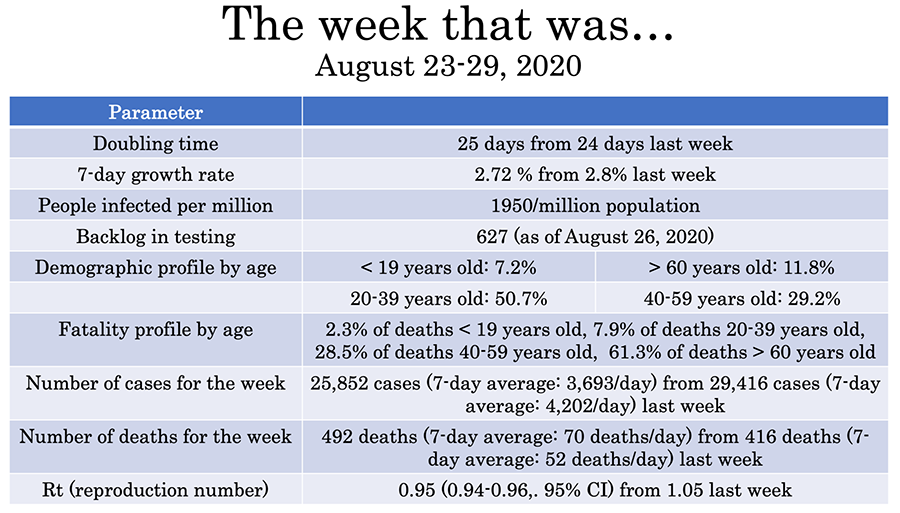
It was a slightly better week.
The doubling time stays the same with a slight decline in the seven-day growth average of cases.
Of course, the total number of people infected per million population is up now at 1,950/million (from last week’s 1,690/million)
As of August 26, there is fewer testing backlog
The demographic profile of age and fatality profile by age remains unchanged, which is the greatest contributor to the cases are the working class (20 to 39 and 40 to 59 years old). Those younger than 19 and more than 60 years old are “locked-down” during the quarantine period. The death rate, however, is highest in the group for senior citizens (61.3 percent of deaths belonged to this age group). This is followed by the 40 to 59 years old age group that accounted for 28.5 percent of deaths.
There are fewer cases this week than last week, a decline of 4,202 cases/day to 3,693/day.
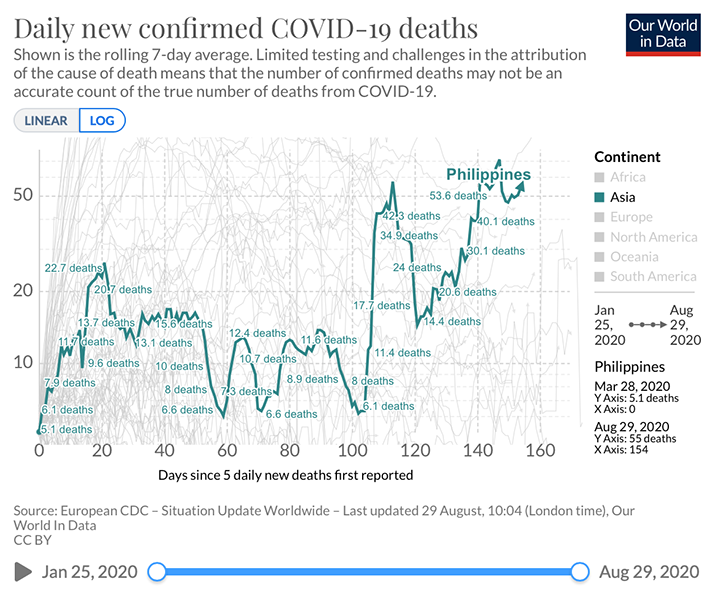
There are more deaths this week than last week, a rise to 70 deaths/day from 52 deaths/day.
The reproduction number (Rt) is 0.95 (less than 1) compared to 1.05 last week. Hopefully we can sustain this for at least two consecutive weeks and more.
The cumulative positivity rate from testing is 10.6 percent (up from 10.4 percent last week).
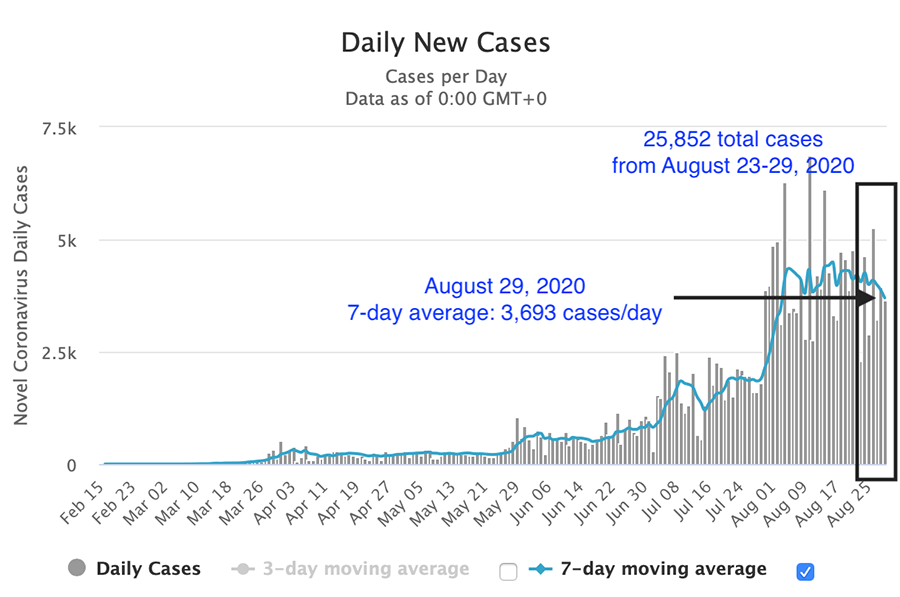

The Philippines remains on an uptrend in new confirmed cases. As a matter of fact, we have never seen a drop in the number of cases even after any and every form of quarantine.
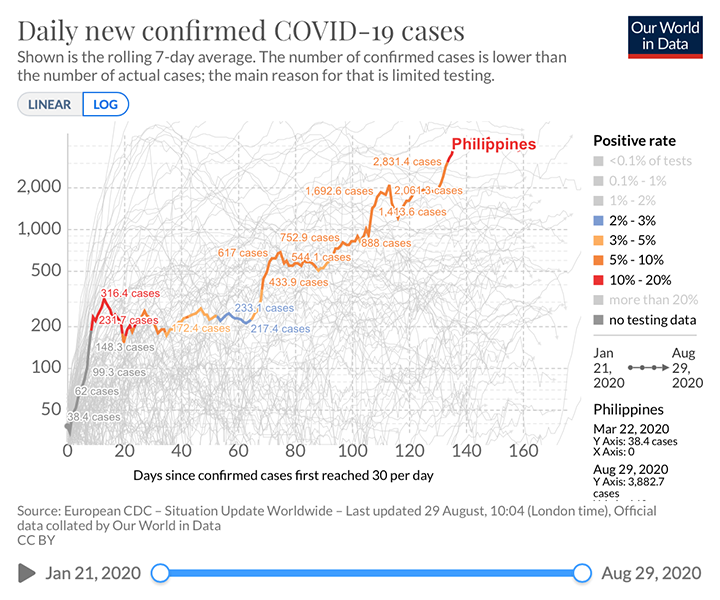
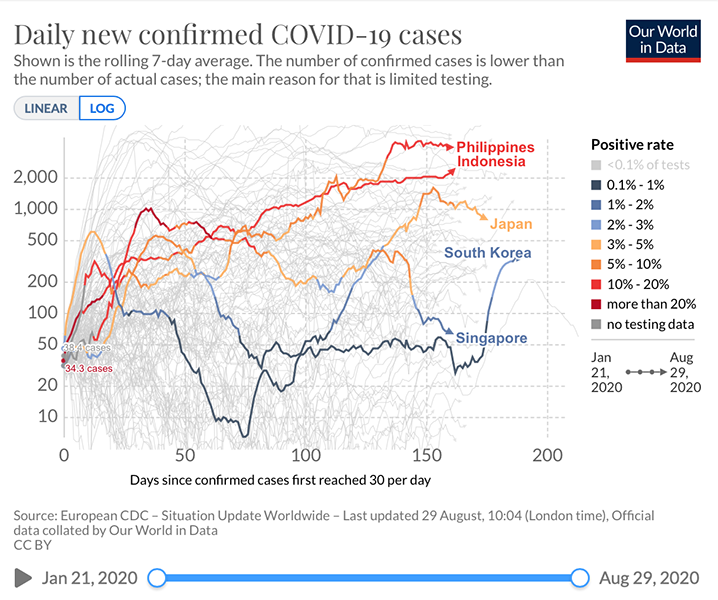
When compared to some of the other countries in the Asian/ASEAN region that are now experiencing a second wave, notice the starting points, how long it took for each these countries to arrive at 30 cases per day, when they were able to “bend the curve” and where we currently (still) are in the pandemic.
There is one other country that is doing just as poorly and not testing enough as well, our southern-most neighbor Indonesia. While Japan lags behind in testing compared to the Philippines, they paid a dear price for this gap accounting for their second wave.
The past weeks has seen a surge in new confirmed deaths due to COVID-19 in the country. The incursions in the graph below tell us that we have erratic reporting of data. Nevertheless, its upward trajectory has been sustained.
The data on deaths usually come in four to eight weeks after the cases are reported. This accounts for the sudden plateau for the case fatality rate in the country compared to the past months where the decline was considerably steeper.
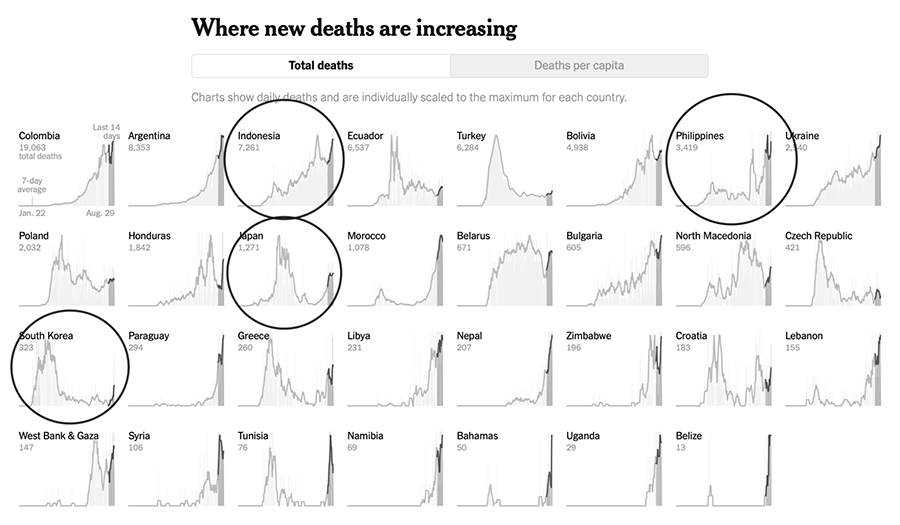
This past week has placed the Philippines as one of the 31 countries that are being watched closely for increase in cases of deaths in the last 14 days. The other countries in Asia include Japan, South Korea and Indonesia.
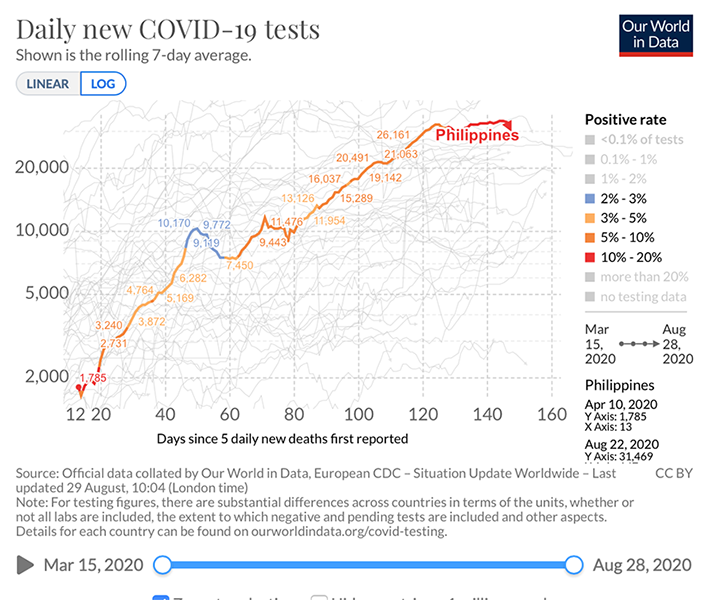
While there are days where the number of tests exceed 30,000 tests/day, notice in spite of the 30,000 plus tests being done, our daily positivity rate is in the red zone (10 to 20 percent). This simply implies that we still are not testing enough. In spite of the increase in testing facilities in the country, the actual number of tests are still within the same numbers as it was over a months ago. Let me reiterate – it is not the number of testing facilities that counts. It is the number of tests done out of these testing facilities that should be the gauge of efficiency.