
Here are who you should test for COVID among your returning workers
As companies start to reopen business, we all hope to return to some semblance of normalcy. Thus, the billion-dollar question for employers: “To test or not to test?” How aggressive should we go in terms of testing? Do employers need to subject their employees to COVID-19 test when they return for work? The latest ANCX Forum co-presented by Art Rocks, a group of art collectors in the Philippines, hopes to answer these questions.
Different kinds of tests
Dr. Cristobal Dumo, a Fellow of the Phil Society of Microbiology and Infectious Diseases, starts by explaining that there are two types of tests that are employed by our hospitals to diagnose SARS-CoV-2. One involves a test of viral RNA (ribonucleic acid). “The viral RNA is the nuclear material of the virus. It is amplified a million times, and if the viral RNA is present, it’s labeled positive or COVID confirmed. [This test] is very sensitive,” he says.
This test involves inserting a long swab in the nose to get some specimen. “It’s unsightly, it’s painful and few people relish the idea of being tested for viral RNA. The technology is Reverse Transcriptase PCR (polymerase chain reaction). It’s able to detect very small levels of the virus,” he adds.
A key caveat to this type of test: while it detects the COVID-19 virus, it’s not able to distinguish if the virus is dead or alive, because a dead virus still contains RNA. “That’s the weakness of the PCR,” notes Dr. Dumo, who’s also a Fellow of the Philippine College of Physicians.
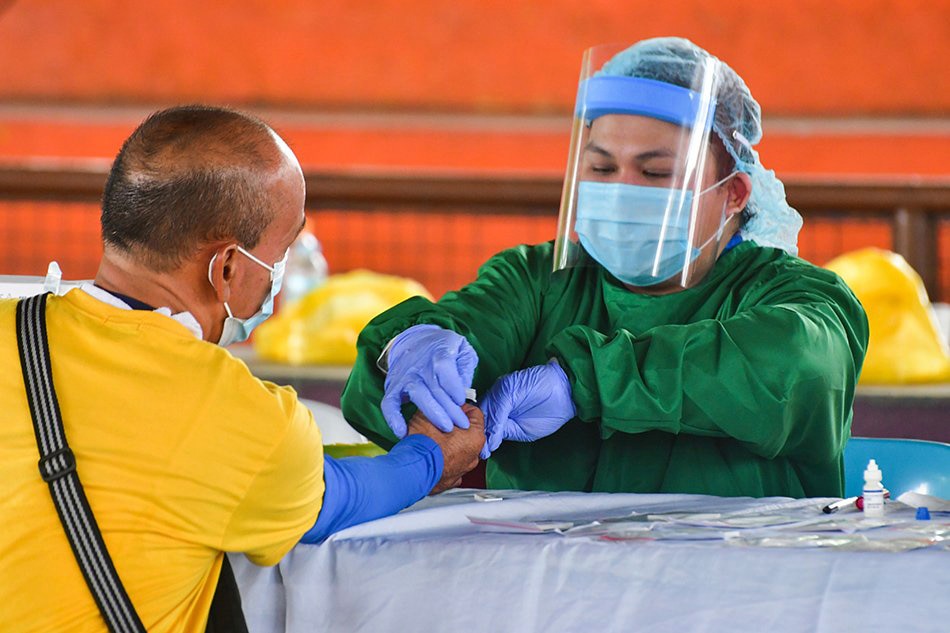
The other type, called serology, tests the immune system. “It’s a blood test, but it’s very similar to your pregnancy kit. It measures the amount of antibodies [in your blood]. If a band appears, that means you have COVID-19 or you may have had it,” he says. When you get infected, you don’t produce any antibodies right away. Your immune system kicks in after some time and develops certain types of antibodies and they show up in your blood.
The serology test may be rapid (you can do it bedside like a pregnancy test) or lab based. The more sensitive lab test is called the ELISA (enzyme-linked immunoassay) test. “This requires machines and it takes about a day or two before the result comes out. Generally, it’s far more sensitive than the RDTs (rapid diagnostic tests).
A small part of everything
Dr. Dumo emphasizes that business owners need to make sure that all the hierarchy of controls are covered, namely (in order of importance): elimination, substitution, engineering controls, administrative controls, and personal protective equipment.
He observes that locally, a lot of attention has been focused on the use of PPEs. However, according to the Centers for Disease Control and Prevention’ Hierarchy of Controls, PPE is at the bottom of the pyramid. (The Hierarchy of Controls has been used as a means of determining how to implement feasible and effective control solutions to protect workers from occupational hazards.) “The PPE is not ineffective. What we’re saying is it’s least effective. We spend an enormous amount of resources on PPEs but yung level of control nya, yung impact, is not as large as a simple elimination activity,” Dumo says.
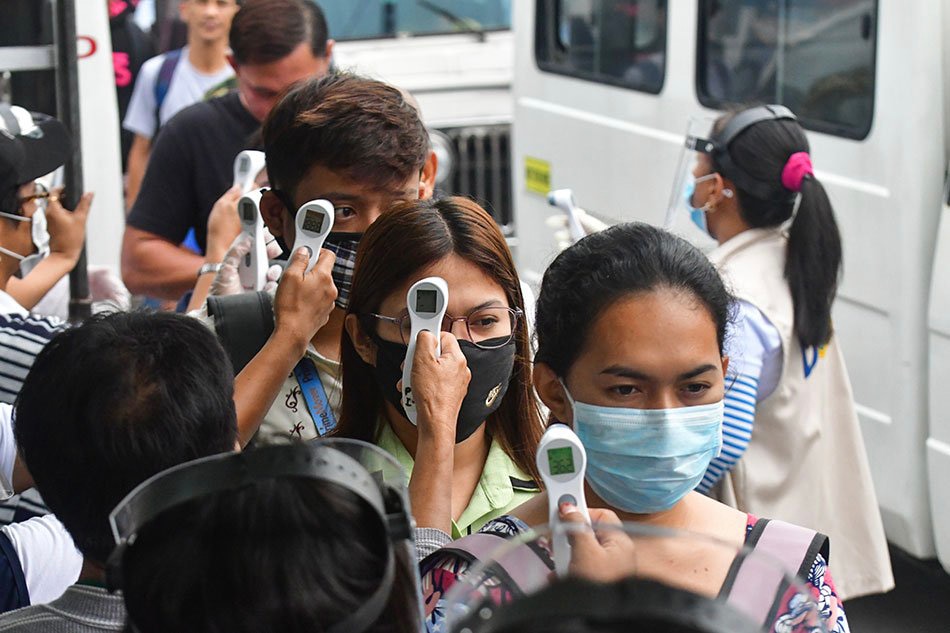
“When workers come in, the concept of symptom screening is the sample of elimination,” he explains. This means eliminating physical access to workers with possible symptoms of COVID, thereby allowing you to protect your remaining employees. “The question of which to test and when becomes secondary na lang kasi we always say symptom screening is much more important at this point in time than routine testing.”
In the latest return to work guidelines issued by the Department of Health, it can be gleaned that the main focus is symptom screening, says Dr. Dumo. “Daily temperature and symptom check has to be recorded. You make sure that anyone with symptoms, travel history, or exposure history has to be reported before they go to the office. Testing comes in a very, very small reminder at the end of the document—it says you do not need to test routinely but may test a representative sample of the high risk group,” he stresses.
Who and how do we test?
Risk based is deemed the best strategy when deciding who to test, according to CDC’s Occupational Risk Pyramid for COVID-19. CDC categorized workers into four: very high risk or those with potential exposure to COVID-19 during medical, postmortem, or laboratory procedures (aerosol, specimen handling); high exposure risk or those with potential exposure to COVID-19; medium exposure risk or those who have frequent and/or close contact (within six feet) with potential COVID 19 or has contact with general public (with community transmission) or travelers (no community transmission); and low exposure risk, or those who have no contact with COVID 19.
In the country, this risk categorization is also applied, but the categories are referred to as Subgroups A to D, respectively. “In rank order, priority ang A over B, over C, over D. In Subgroup A, it doesn’t matter whether you’re a patient or a healthcare worker, if you have severe symptoms, kailangan mong ma-ICU, kailangan kang ma-test. In Subgroup B, if you have mild symptoms, pero may travel history ka or you belong to the vulnerable population (senior citizens with health conditions like diabetes), you are a COVID suspect, you need to get tested. Subgroup C, you have mild symptoms. Subgroup D, you’re asymptomatic but with probable exposure. Pag walang exposure, considered low priority.”
Patients who are COVID suspects and who are symptomatic need to be tested, Dumo explains further. “In order of preference, it’s severe, followed by mild vulnerable, and mild. The test of choice is swab for PCR because it detects the virus. For those who are recovering na confirmed COVID-19 cases, we still need to test them. Hindi natin sila pwedeng pabayaan kasi we’re still in the early part of the pandemic. Where possible, you do PCR. There’s a debate whether you need two consecutive tests or just one test. I think one test is good enough as long as you combine it with an antibody test (IgG positive).”
Healthcare workers or personnel who are in contact with the public (meaning, on a sustained basis, less than 6 feet apart, for more than 15 minutes), have to be tested.
“All of us are considered COVID suspects or possibly harboring COVID, that is why the concept of symptom screening comes in. When you do exposure risk-based testing, this has to be in conjunction with all the other sorts of controls—hindi mo papapasukin kalahati ng opisina, so that exposure is only half,” he says. “Dun sa kailangang pumasok, tanggalin na lahat ng may symptoms para only the healthy ones are in the office. For those in the office, sino ang pinaka at risk of COVID transmission? Yung mga iyon ang kailangan mong i-test.”
